Beyond the Booth: How Rivalry Commerce Creates New Digital Revenue Real Estate

Additional Drop Opportunities
For decades, the commercial value surrounding live events has been shaped by physical limitations.
A venue has only so many entrances, walls, concourses, premium areas and places where a banner can be installed. A festival has only so much ground available for booths. A fair can accept only the number of vendors its footprint, operating requirements and audience flow can support. Every additional physical placement requires space, coordination and, in many cases, staffing, installation, inventory and logistics.
Once those available spaces are committed, the commercial inventory is effectively full.
The audience, however, is not confined to that physical footprint.
Its attention begins before the event. It intensifies during the live experience. It continues afterward. That attention already exists, but traditional event commerce has had limited infrastructure for turning the full timeline into additional, controlled sponsor and vendor opportunities.
Rivalry Commerce changes that structure.
Rivalry Commerce does not view a digital drop as only a product offer. It recognizes that every approved drop can also create new licensed digital real estate: space that may be rented to an approved sponsor, space that may be rented to approved vendors and space that can be activated repeatedly across the pre-event, live-runtime and post-event windows.
The innovation is not simply that an event can offer more drops.
It is that Rivalry Commerce creates more revenue opportunities inside every approved drop.
Physical Inventory Limits
Traditional sponsorship and vendor participation depend heavily on physical availability.
A sponsor may rent signage, a banner, a hospitality area, a branded activation or another defined location. A vendor may rent a booth, table or designated sales area. These arrangements can be valuable, but their capacity is naturally limited.
Physical sponsor inventory is restricted by the number of appropriate placements available at the event. Not every surface can become another banner. Additional signage may require design, printing, installation, removal, venue approval and operational coordination.
Physical vendor inventory faces similar limits. Every vendor requires an approved location, access, staffing and a plan for setup and breakdown. Vendors may need to transport products, equipment or displays. The event must consider utilities, crowd movement, safety, operating hours and the overall appearance of the environment.
These constraints mean demand can exceed capacity even when the event has an engaged audience and additional businesses want to participate.
The issue is not a lack of commercial interest. It is a lack of expandable physical inventory.
Rivalry Commerce creates another category of inventory—one that does not require the event to find another wall, print another banner or place another booth onsite.
Layered Revenue Opportunity
In a conventional digital merchandise moment, the primary commercial opportunity is the product being offered.
Rivalry Commerce expands what that moment can contain.
Within a rights-holder-approved deployment, a scheduled drop can include a licensed offer, a sponsor banner placement and approved vendor rental positions. Each component is governed within the same event-connected environment, but each represents a distinct commercial opportunity.
That means one drop may produce several revenue layers:
- Revenue associated with the primary licensed drop
- Revenue from a rented sponsor banner placement
- Revenue from approved vendor rental positions
- Extended partner visibility within the defined drop window
The drop is no longer only a moment in which merchandise can be presented. It becomes a piece of licensed digital commercial real estate.
When the event schedules multiple drops, that inventory can be created again across additional approved moments.
This distinction is essential. Rivalry Commerce is not merely moving a physical booth onto a phone. It is establishing an event-scoped digital structure in which new commercial positions can be defined, approved, scheduled and rented without increasing the physical burden on the event.
Sponsor Banner Inventory
Sponsors already understand the value of being present where audience attention is concentrated.
Traditional sponsorship often delivers that presence through physical signage, fixed branding, hospitality, announcements or onsite activations. These placements remain important, and Rivalry Commerce does not replace them.
It creates an additional form of sponsor inventory.
A digital sponsor banner can be assigned to an approved drop within the Rivalry Commerce deployment. Instead of appearing only in a physical location, the sponsor is positioned within a scheduled commercial moment connected to the event.
The placement can occur during a pre-event drop while anticipation is building. It can appear during an approved live-runtime drop when audience engagement is at its strongest. It can support a post-event drop while the audience is still connected to the experience.
This creates sponsor visibility without requiring:
- Additional physical banner space
- Printing or production of another onsite sign
- Installation and removal
- Sponsor personnel at the event
- A physical activation footprint
- Changes to venue operations
Most importantly, the sponsor opportunity is not necessarily limited to a single static placement.
If an event has multiple approved drops, it can have multiple digital sponsor banner opportunities. Each available placement becomes definable commercial inventory under the authority of the rights holder.
For example, a pre-event sequence containing several drops does not have to rely on one sponsor opportunity for the entire period. Individual drops may create separate approved sponsor-banner positions. Live and post-event drops can create additional positions of their own.
The number and structure of those opportunities are determined by the deployment—not by the number of walls available at the venue.
Vendor Participation
Vendors face a different version of the same physical constraint.
Traditional event participation often requires a vendor to secure a booth, transport merchandise, prepare a display, staff the location and manage sales during fixed operating hours. The event must allocate space and coordinate participation within the physical environment.
Rivalry Commerce creates another path.
Approved vendors can rent digital positions within scheduled drops. These positions allow relevant vendors to be presented to the event audience without requiring an onsite booth or physical inventory at the venue.
The vendor maintains control of its business. Its products remain its own. Its approved payment destination remains its own. Its order handling and fulfillment remain its own. Rivalry Commerce does not take possession of the vendor’s inventory, process the vendor’s payments or become responsible for fulfilling the vendor’s orders.
Rivalry Commerce creates the governed access and event-connected visibility. The vendor continues to sell and fulfill through its established operations.
This removes several physical barriers that can otherwise prevent participation. A vendor does not need to:
- Transport inventory to the venue
- Build or staff an onsite booth
- Install physical signage
- Remain open for the event’s operating hours
- Process orders through Rivalry Commerce
- Change its established fulfillment process
For the event, the vendor opportunity does not consume additional floor space or create another onsite workflow. For the vendor, participation can extend beyond the people who happen to walk past one physical location.
The result is not an uncontrolled digital marketplace. Vendor participation remains approved and governed. The rights holder determines which vendors may appear, how many positions are available and where those opportunities fit within the event deployment.
Multiple Inventory Sets
The full value becomes clear when the drop structure is viewed across the entire event lifecycle.
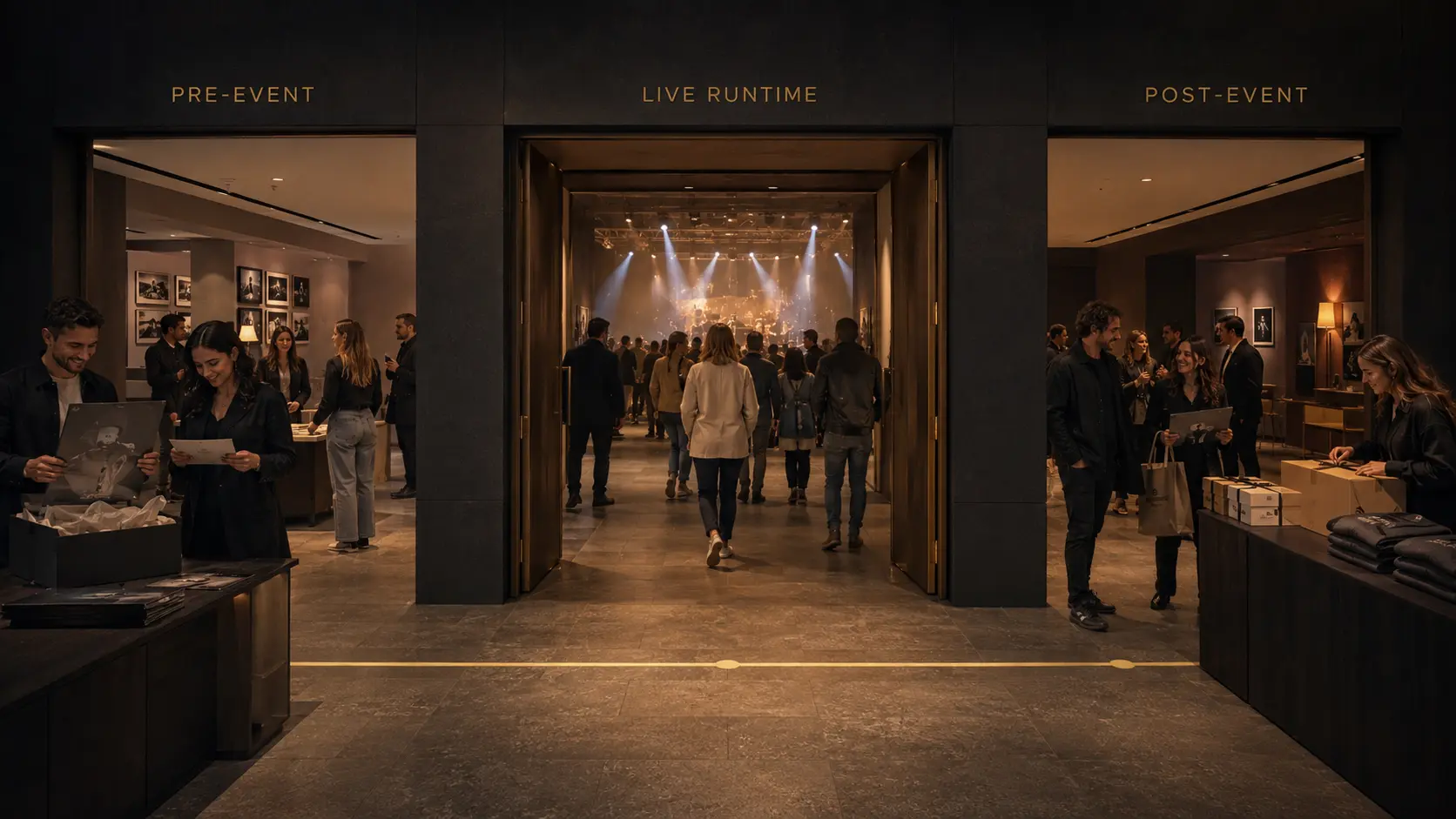
Rivalry Commerce operates through three commercial windows:
- Pre-event
- Live runtime
- Post-event
Each window can contain multiple drops. Each approved drop can contain multiple revenue opportunities.
Consider the structure at its simplest. If one drop includes a primary licensed offer, a sponsor-banner position and two approved vendor positions, that single drop contains four potential commercial components. If the event schedules another drop, a new set of approved inventory can become available. As additional drops are deployed across the lifecycle, the number of potential commercial moments expands.
This is how Rivalry Commerce monetizes further than the traditional event structure initially suggests.
The event is not limited to asking, “How much can this one drop sell?”
It can also ask:
- Is there an approved sponsor placement within this drop?
- Are there approved vendor rental positions within this drop?
- Can another drop create a different set of partner opportunities?
- Can the structure continue into the next event window?
- Can the deployment be repeated at the next event or tour stop?
One event can therefore support a governed sequence of digital commercial environments rather than a single isolated transaction window.
The audience attention already exists. Rivalry Commerce creates additional inventory within that attention.
Additive Revenue
The purpose of this structure is not to redirect or diminish existing event revenue.
Current merchandise operations can continue. Existing sponsor agreements can continue. Physical vendor participation can continue. Ticketing, concessions and venue retail remain in place.
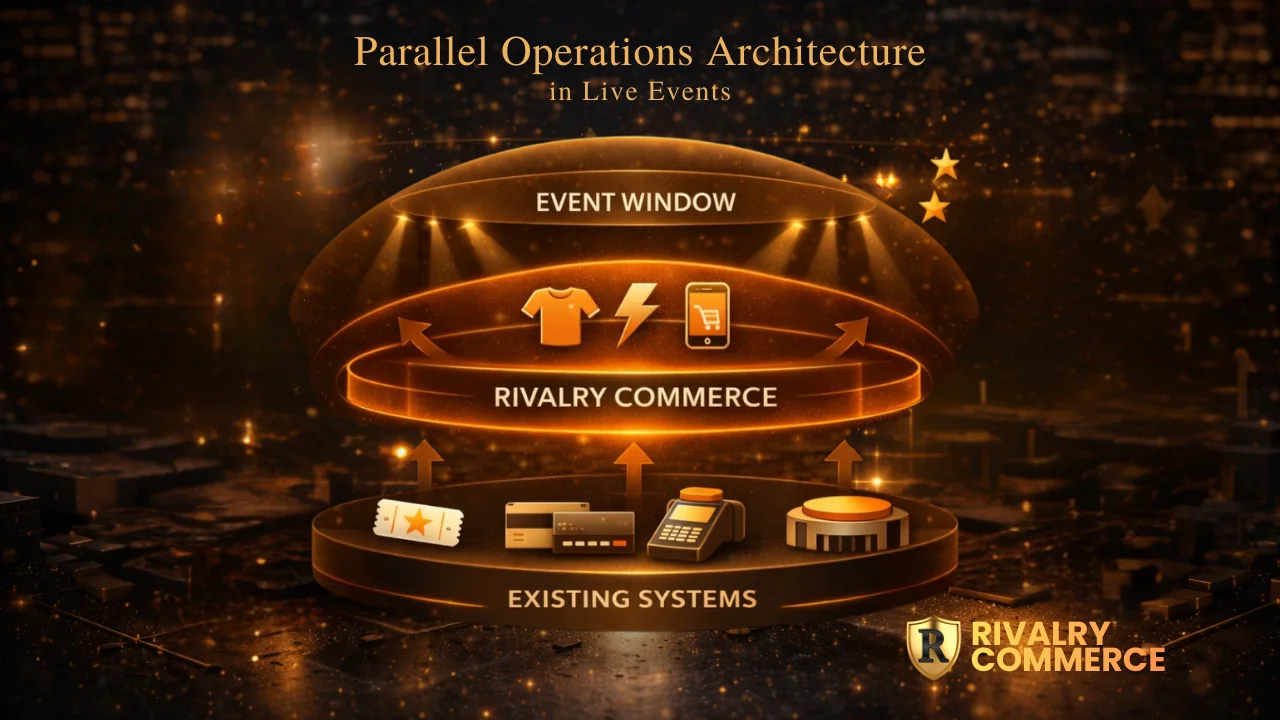
Rivalry Commerce operates as an independent, parallel layer that creates new digital inventory around the existing event structure.
This means a sponsor banner within an approved digital drop is not another physical sign competing for venue space. It is a new commercial position within a digital event moment.
A vendor rental position within a drop is not another booth competing for floor space. It is an additional governed opportunity for an approved vendor to reach the event audience digitally.
The licensed product drop itself does not require the event to eliminate its current merchandise operation. It creates another timed opportunity across the broader lifecycle.
The distinction protects what the event already earns while creating opportunities to earn more.
That is the meaning of additive revenue: current revenue remains intact while Rivalry Commerce establishes commercial inventory that did not previously exist in a structured, rentable form.
No Added Footprint
Expanding commercial inventory traditionally creates more operational work.
Another banner may require another approval, production schedule and installation plan. Another booth may require another vendor agreement, space assignment, credential, setup window and onsite contact. Another physical sales area may require staff, equipment, inventory and payment operations.
Rivalry Commerce separates additional commercial inventory from those physical requirements.
Once an approved deployment is established and scheduled, its drops operate digitally. Rivalry Commerce is not onsite. It does not require a booth. It does not require the event to print banners, store products, add personnel or create new venue logistics for the layer.
This is particularly important because it allows the event to expand commercial opportunity without expanding operational complexity at the same rate.
The event gains more rentable positions, but it does not gain another physical setup to manage for every position created.
That operational separation is what makes the model scalable across multiple drops, multiple event days and multiple tour stops.
Rights-Holder Control
Creating more inventory cannot mean giving outside businesses uncontrolled access to the audience.
Rivalry Commerce is built around rights-holder authority and governed access.
The rights holder controls:
- Which sponsors may participate
- Which vendors may participate
- Which drops can contain partner placements
- How many positions are available
- When each drop becomes active
- Which products and offers may appear
- How the commercial environment aligns with the event
- How long each opportunity remains available
This makes the digital real estate licensed and intentional.
Sponsors and vendors are not simply purchasing access to a list of attendees. They are participating within an approved event-connected deployment. Their visibility exists because the rights holder has authorized the commercial opportunity and Rivalry Commerce has orchestrated it within the defined layer.
This protects brand integrity while allowing the event to benefit from a broader set of commercial relationships.
It also preserves scarcity. Digital does not have to mean unlimited. The event can determine how many sponsor and vendor positions are appropriate, maintaining the value of each available placement.
Sponsor Value
The Rivalry Commerce structure gives approved sponsors more than another place to display a name.
It creates the opportunity to appear within a specific commercial moment connected to the event lifecycle. That placement can be timed, measured and associated with a defined drop rather than existing only as general background exposure.
Sponsors can gain:
- Visibility before the event begins
- Presence during approved live-runtime moments
- Continued exposure after the event
- Association with a specific licensed drop
- Measurable impressions within the deployment
- Additional opportunities across multiple drops or tour stops
For sponsors already participating in the physical event, digital drop placement can extend the value of their involvement. For approved sponsors that do not require an onsite activation, it can create a path to participation without consuming physical event inventory.
The result is a broader sponsorship structure that complements existing packages while introducing additional digital positions that can be licensed separately or incorporated into larger agreements.
Vendor Opportunity
The same structure expands what vendor participation can mean.
An approved vendor can gain event-connected visibility without the cost and operational burden of a physical booth. Because the vendor controls its own commerce and fulfillment, it can participate through the digital layer while continuing to operate through its existing business processes.
This can create opportunities for vendors that are relevant to the audience but are not suited to an onsite setup. It can also allow the event to include more approved businesses than its physical footprint would otherwise support.
Vendor exposure can begin before event day, continue through approved live drops and extend into the post-event period. A vendor is no longer dependent on one location, one operating schedule or the portion of the audience that happens to pass a booth.
For the rights holder, every approved vendor position represents a new rentable opportunity. For the vendor, it represents governed access to a high-intent event audience. For the ticket holder, it creates another relevant discovery point within the event-connected experience.
Repeatable Across Events
The value of digital commercial real estate is not limited to a single event.
For recurring events, the structure can be deployed again under a new approved timeline. For multi-day events, drops can be scheduled across different days and operating windows. For tours, sponsor and vendor opportunities can be organized by city or stop while remaining under central rights-holder authority.
This creates the possibility of repeatable inventory.
A sponsor may participate across an entire tour, within selected cities or during specific drops. A vendor may be approved for one market, a series of stops or a particular event window. The rights holder can preserve consistent governance while adjusting participation to fit each deployment.
Performance can then be evaluated across drops and locations. Sponsor impressions, vendor engagement, audience entry, order activity and drop performance can help show which opportunities created the strongest response.
That information makes future digital inventory more informed and more valuable.
Beyond Physical Limits
The live-event industry already understands how to monetize physical space.
Rivalry Commerce extends that thinking into a new licensed environment.
Instead of asking only how many banners can fit inside the venue, it asks how many appropriate sponsor opportunities can be created across the digital event lifecycle.
Instead of asking only how many vendor booths the floor plan can hold, it asks how many approved vendor positions can be structured across multiple drops.
Instead of treating one drop as one revenue opportunity, it recognizes that the drop itself can contain several distinct, rentable commercial positions.
This is how Rivalry Commerce thinks beyond the booth.
It does not attempt to place more physical objects into an already finite environment. It establishes additional digital real estate around the attention the event has already created.
Commercial Equation
The traditional equation is limited by physical capacity:
Available space × event operating hours = available commercial inventory.
Rivalry Commerce adds a new equation:
Approved drops × sponsor and vendor positions × event lifecycle windows = additional digital revenue opportunities.
The number of opportunities is not arbitrary. Every placement remains subject to rights-holder approval, brand standards and the structure of the deployment. But the commercial ceiling is no longer determined solely by the venue’s physical footprint.
That is the larger opportunity Rivalry Commerce created.
The company did not simply find another way to sell a product. It created a method for turning approved drops into licensed digital commercial environments—each capable of supporting the primary offer, sponsor-banner rental revenue and approved vendor-placement rental revenue.
More drops create more commercial moments. More commercial moments create more rentable inventory. More rentable inventory creates additional revenue without requiring more physical space.
Beyond the Booth
Live events will continue to rely on physical sponsorships, merchandise, concessions and vendor participation. Those operations remain essential.
But they no longer have to represent the complete commercial boundary of the event.
Rivalry Commerce creates an additional layer of governed digital real estate that can operate before the event, during live runtime and afterward. Within that layer, every approved drop can become more than a product moment. It can create sponsor-banner inventory, vendor rental inventory and extended event-connected visibility.
No additional booth is required.
No additional physical banner is required.
No Rivalry Commerce staff is required onsite.
No existing revenue operation must be replaced.
The event already creates the attention. Rivalry Commerce creates more approved ways to monetize it.
Physical commercial space is finite. Rivalry Commerce expands the commercial opportunity beyond it.
About Rivalry Commerce
Rivalry Commerce provides Licensed Revenue Infrastructure for Live Events™. Its independent, rights-holder-controlled commerce layer operates across pre-event, live-runtime and post-event windows, creating additional opportunities for licensed drops, digital sponsor-banner rentals and approved vendor placements without displacing existing event operations.
You approve the deployment. We orchestrate the layer.
To explore sponsor and vendor revenue opportunities for an upcoming event, request a deployment with Rivalry Commerce.