Why Do I Need Rivalry Commerce?
Value Beyond Event Day
You already have an event operation.
You may already have ticketing, merchandise, concessions, sponsors, vendors, licensing relationships, venue teams and established revenue channels. Those operations may be experienced, effective and essential to the event.
Rivalry Commerce does not exist because any of those operations are broken.
It exists because they were built primarily to serve the physical event, while the commercial value of an audience begins long before the gates open and continues long after the venue clears.
That distinction matters.
An event does not begin when the first attendee arrives. It begins when the audience becomes aware, makes a decision, secures access, starts anticipating the experience and begins paying attention. The commercial timeline grows as the event approaches, reaches its greatest intensity during the live experience and continues afterward through memory, conversation, shared content and ongoing affinity.
Yet most event commerce remains concentrated within a much narrower window.
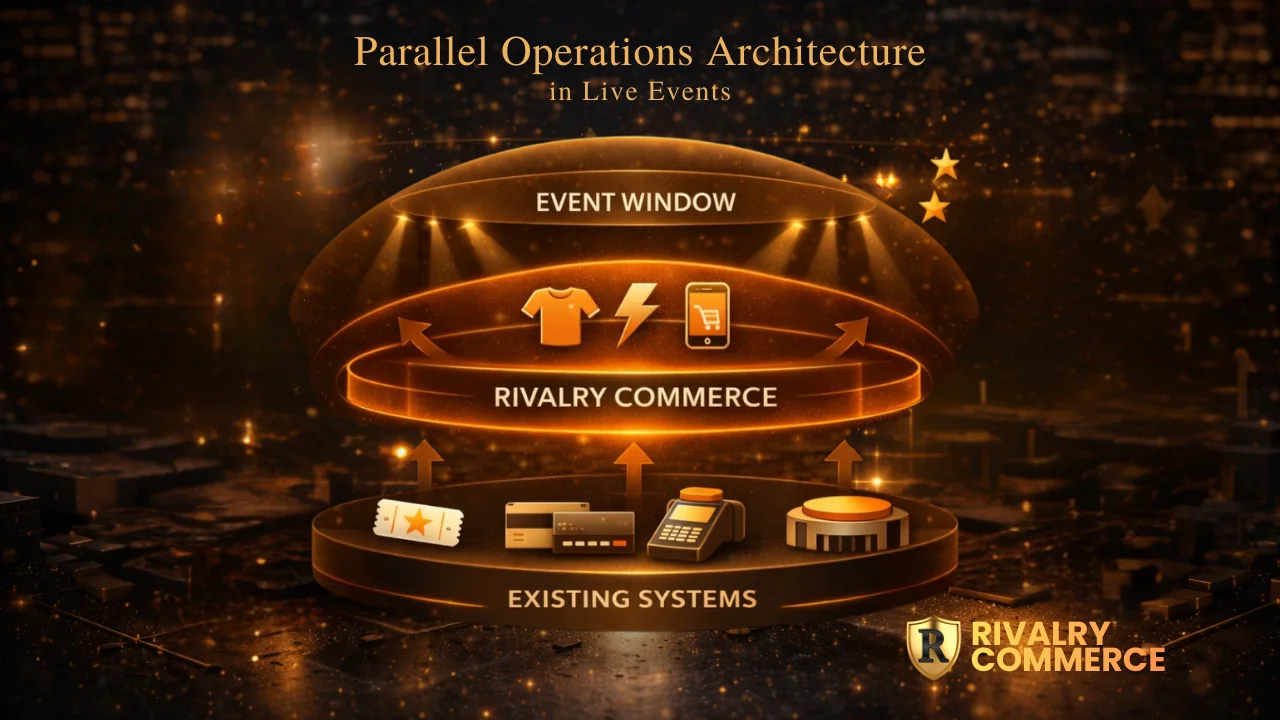
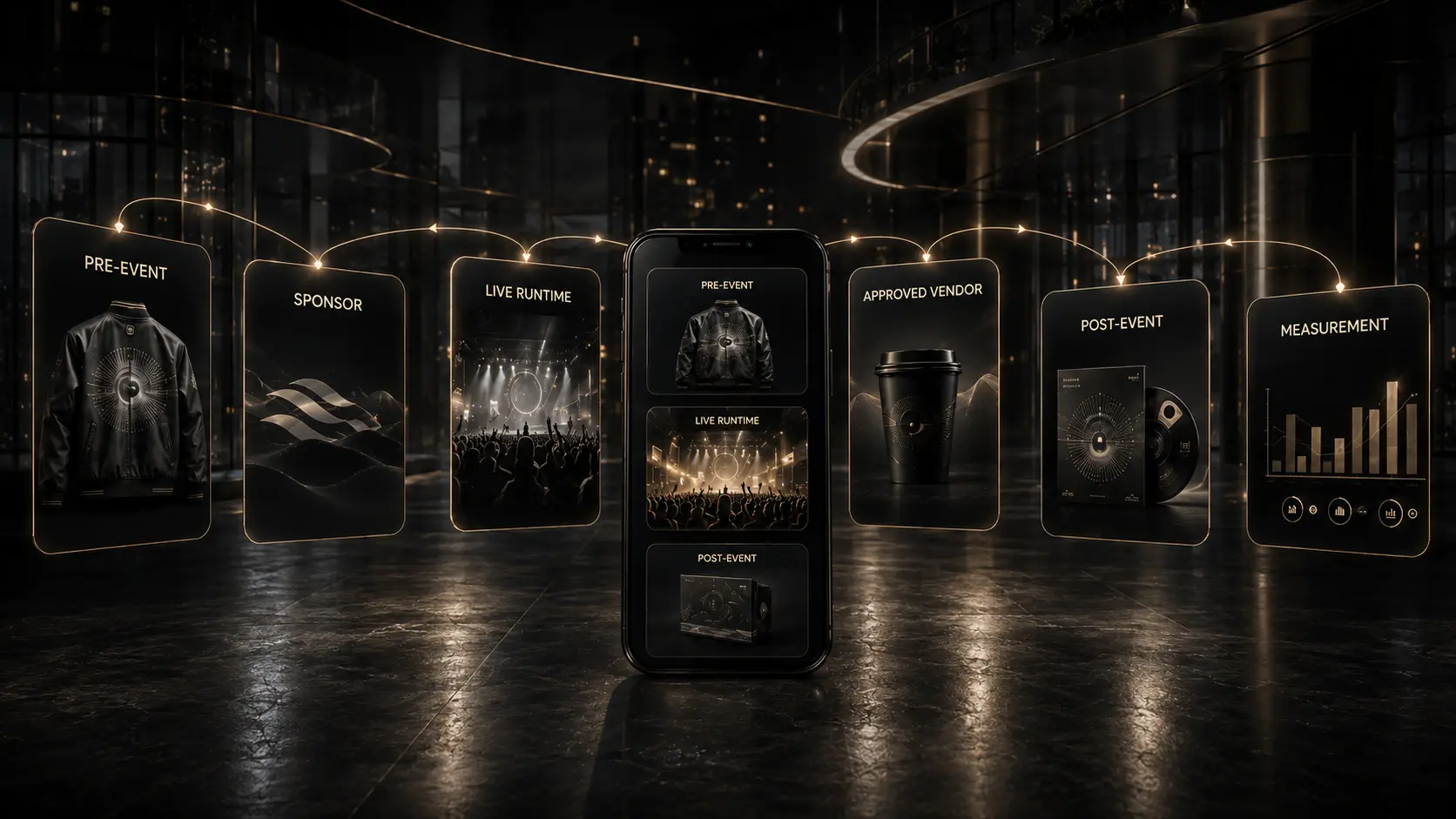
Rivalry Commerce was created to activate the value outside that narrow window without interfering with the operations already in place. It establishes licensed revenue infrastructure across the full event lifecycle: pre-event, live runtime and post-event.
The simplest answer to the question is this:
You do not need Rivalry Commerce to replace something that is broken. You need Rivalry Commerce to activate commercial value your current event infrastructure was never designed to capture.
Audience Opportunity
Every live event creates a period of concentrated attention.
Before the event, ticket holders are making plans, following announcements, discussing what they will wear, deciding who will attend with them and imagining the experience ahead. During the event, attention becomes immediate and emotional. Afterward, the experience continues through memories, photos, conversations and the desire to hold onto what just happened.
That attention already exists. It is not something the event must manufacture from nothing.
The question is whether the rights holder has licensed infrastructure designed to use more of that attention responsibly, intentionally and commercially.
Traditional operations capture important parts of the event. Ticketing secures access. Onsite merchandise serves immediate demand. Concessions support the physical experience. Sponsors receive contracted visibility. Vendors participate within the space and terms made available to them.
But those functions do not automatically create a coordinated series of approved commerce moments across the entire audience timeline.
Without Rivalry Commerce, the event may have significant commercial attention with no dedicated layer through which to activate it. The audience is present. The interest is present. The rights are present. The missing element is an infrastructure that can organize those assets into controlled, measurable opportunities without burdening the live operation.
Capturing the Full Timeline
For many events, commerce is still treated as an event-day activity.
That model leaves two valuable windows underused.
The first is the period before the event, when anticipation is building. This window can support scheduled merchandise drops, approved sponsor placements and limited vendor opportunities tied to the audience’s growing attention.
The second is the period after the event, when emotion and memory remain active. This window can support encore merchandise, post-event drops and continued visibility for approved commercial participants.
Rivalry Commerce adds structure to all three windows.
Pre-Event
The pre-event period becomes an active, scheduled commerce window rather than a passive waiting period. Multiple approved drops can be deployed as the event approaches. Sponsors can occupy designated digital placements. Approved vendors can participate through governed opportunities without requiring physical event space.
The purpose is not to overwhelm the audience. It is to create controlled moments that are relevant to the event and authorized by the rights holder.
Live Runtime
During the live event, commerce can respond to the timing and energy of the experience. Approved drops can be released at designated moments without changing venue retail, concession, ticketing or staffing workflows.
The live window is not treated as a constant sales feed. It is governed. Timing, content and participation remain under rights-holder authority.
Post-Event
After the event, the commercial relationship does not have to end when the audience leaves the venue. Approved encore drops and memory-driven offers can extend the value of the experience while it is still meaningful.
This is how one event becomes more than one short transaction window. The event remains the center of the experience, while its licensed commercial timeline becomes wider.
Revenue Without Interference
This is one of the most important reasons Rivalry Commerce exists.
Additional revenue should not require an event to dismantle, replace or compete with the revenue it already has.
Rivalry Commerce operates as an independent, parallel layer. Existing merchandise continues. Existing concessions continue. Existing sponsors, vendors, ticketing relationships and venue operations remain in place.
The added layer creates new commercial inventory around those operations rather than taking their place.
That inventory can include:
- Multiple merchandise drops across one event lifecycle
- Sponsored drop placements
- Digital sponsor-banner rental opportunities
- Approved vendor rental opportunities
- Encore and post-event commerce windows
- Repeatable opportunities across tour stops, cities or recurring events
These are additional revenue layers. They do not require the rights holder to surrender existing revenue or displace existing commercial relationships.
This matters because many organizations are not looking for another replacement initiative. They are looking for growth that respects the value of what has already been built.
Rivalry Commerce meets that requirement by expanding the commercial timeline instead of replacing the current operation.
Sponsor Inventory Beyond Signage
Physical sponsor inventory is limited by space, placement, production schedules and the realities of the venue.
There are only so many banners that can be printed, only so many positions that can be assigned and only so much physical visibility that can be introduced before the environment becomes crowded.
Rivalry Commerce creates licensed digital real estate that exists alongside physical sponsorship inventory.
Approved sponsors can be associated with specific drops, designated placements or defined moments across the event lifecycle. A sponsor’s participation can begin before the venue opens, remain relevant during live runtime and extend into the post-event period, depending on the deployment approved by the rights holder.
This expands sponsor inventory without requiring another physical banner, booth or onsite activation.
It also creates a more measurable form of participation. Rather than relying only on general exposure, the added layer can track engagement associated with the deployment, including entries, visibility, drop activity and other approved performance measures.
The result is not simply more advertising. It is additional governed sponsor inventory connected to the audience’s event journey.
Vendor Access Without Onsite Space
Vendor participation is often constrained by physical capacity.
Onsite space is finite. Every physical vendor may require footprint, logistics, credentials, staffing, setup, breakdown and operational coordination. Those realities limit how many vendors can participate and how their participation can be structured.
Rivalry Commerce creates a separate digital opportunity for approved vendors.
Vendors can rent designated participation within approved drops or commerce windows without occupying physical event space. They retain control of their own products, sales process and payment links. Rivalry Commerce does not take over the vendor’s business or present itself as the vendor.
The rights holder determines who may participate and under what terms. The event gains additional commercial inventory. The vendor gains governed access to a relevant audience. The physical operation remains unchanged.
This is especially valuable when an event has more commercial interest than onsite capacity. It allows the rights holder to create opportunity without creating congestion.
Experience Without Added Work
Growth often arrives with a hidden cost: more staff, more logistics, more production, more coordination and more onsite responsibility.
Rivalry Commerce was designed to avoid that burden.
It does not require a Rivalry Commerce booth. It does not require Rivalry Commerce personnel onsite. It does not require printed banners, venue storage, merchandise handling, concession integration or a new staff workflow.
It also does not require ticketing integration.
Audience access can be established through an approved entry point, such as a link or QR entry placed within an authorized event communication or rights-holder environment. From there, the licensed layer operates according to the approved deployment schedule.
The governing principle is simple:
You approve the deployment. We orchestrate the layer.
The rights holder approves timing, products, designs, offers, sponsor participation, vendor participation and the boundaries of the deployment. Rivalry Commerce coordinates the layer within those approvals.
This division of responsibility protects operational authority. It allows the event to add a meaningful digital enhancement for ticket holders without asking venue teams to absorb another onsite operation.
Authority Without Surrender
Any new commercial opportunity must preserve the authority of the rights holder.
Rivalry Commerce is built around governed access.
The rights holder does not hand over unrestricted access to its audience, brand or event. Participation is approved. Timing is approved. Product and creative direction are approved. Commercial windows are defined. The deployment exists within those boundaries.
This is important for licensed properties, artists, teams, event operators and organizations whose reputation depends on maintaining control over how their name, audience and intellectual property are used.
Expansion without governance creates risk. Rivalry Commerce is designed to create expansion with governance.
That is why the layer is licensed and event-scoped. It deploys for the approved lifecycle and operates within the authority granted to it. It is not an open marketplace and does not create uncontrolled access to the audience.
Measuring Added Value
An additional revenue layer should not be treated as an unmeasured presence.
Rivalry Commerce is designed to make the performance of the added layer visible.
Depending on the deployment, performance can include:
- Audience entries and scans
- Subscribers or opted-in participants
- Drop engagement
- Notifications sent, delivered and opened
- Orders and conversion activity
- Sponsor placement visibility and impressions
- Vendor participation performance
- Product-level drop performance
- Comparisons across events, cities or tour stops
- Traffic directed to approved rights-holder or vendor destinations
This measurement helps the rights holder understand what happened, which windows performed, how audiences responded and where future deployments can be strengthened.
For recurring events and tours, measurement becomes even more valuable. Each event or stop can create a performance record. Results can be compared across locations. Timing, products and participation can be refined without changing the fundamental parallel structure.
The event is no longer limited to a single undifferentiated commerce result. It can see how the added layer performed across the lifecycle.
Repeatable Across Events
The value of Rivalry Commerce is not limited to a single date.
For a tour, the licensed layer can deploy by stop. Each city can have its own approved timing, drop sequence, sponsor participation, vendor opportunities and performance record. The structure remains consistent while the deployment responds to the needs of each location.
For recurring events, the layer can return with the next edition and build on prior performance. For multi-day events, commercial windows can be organized across the schedule. For licensed environments, the deployment can be shaped around the rights, audience and operating boundaries that apply.
This creates repeatability without forcing every event into an identical template.
The infrastructure is structured. The deployment is specific.
Why the Gap Remains
It is reasonable to ask whether existing ticketing, merchandise, marketing or event teams could simply perform the same function.
Those teams may already be doing their assigned jobs extremely well. The issue is not capability. It is purpose and structure.
Ticketing is designed to manage access. Merchandise operations are designed to sell products through established channels. Marketing teams are designed to build awareness and communicate. Venue teams are designed to operate the physical event. Sponsorship teams sell and service contracted assets.
Rivalry Commerce connects a different commercial requirement: the orchestration of multiple licensed revenue opportunities across the pre-event, live-runtime and post-event timeline while remaining independent of the physical operation.
Without a dedicated layer, the opportunity may be fragmented across departments or left unused because no existing function owns the complete lifecycle.
Rivalry Commerce gives that opportunity a defined structure, operating model and measurement framework.
Inactive Timeline Cost
When the broader event lifecycle has no dedicated commerce infrastructure, the loss is not always visible on a financial statement.
There may be no line labeled “uncaptured pre-event attention” or “unused post-event commercial window.” There may be no report showing the sponsor inventory that was never created or the approved vendors who could not participate because physical space was full.
But the absence of a line item does not mean the value was not there.
The audience was paying attention. The event was creating relevance. The rights holder possessed authority. The commercial windows opened and closed whether they were activated or not.
Rivalry Commerce makes those windows actionable.
It turns time into structured inventory. It turns approved access into governed participation. It turns sustained audience attention into measurable licensed opportunity.
Who Needs Rivalry Commerce?
Rivalry Commerce is relevant when an organization controls or operates a live-event environment and wants to expand commercial value without disrupting the event.
That may include:
- Rights holders seeking greater control over event-related commerce
- Artists and touring organizations extending value across each stop
- Sports and entertainment properties creating additional licensed opportunities
- Event operators expanding revenue without adding onsite complexity
- Venues supporting approved digital enhancements around their events
- Sponsors seeking additional, measurable inventory
- Approved vendors seeking access without requiring physical footprint
The need is not defined by event size alone.
It is defined by the presence of audience attention, commercial rights and an event lifecycle that currently creates more value than its existing infrastructure can use.
The Executive Decision
The decision is not whether to replace ticketing, merchandise, concessions, sponsorship or venue operations. Rivalry Commerce does none of those things.
The decision is whether the commercial timeline surrounding the event should remain limited to what current operations were designed to capture.
If the objective is to preserve existing operations exactly as they are, while adding approved revenue opportunities before, during and after the event, Rivalry Commerce provides the infrastructure for that expansion.
If the objective is to create additional sponsor and vendor inventory without using more physical space, Rivalry Commerce provides that layer.
If the objective is to keep authority with the rights holder, avoid onsite staffing and logistics, measure performance and repeat the structure across future events, Rivalry Commerce was built for that requirement.
The Answer
You need Rivalry Commerce because your event is already creating more commercial value than event day alone can capture.
You need it because audience attention begins before the event and continues afterward.
You need it because additional revenue should not require the displacement of current revenue.
You need it because physical sponsor inventory and vendor space are finite, while licensed digital opportunity can be structured across the full lifecycle.
You need it because growth should not require another onsite operation.
You need it because rights-holder authority must remain intact.
And you need it because valuable commercial windows should be measurable, repeatable and intentionally governed—not left unused simply because existing infrastructure was built for a different purpose.
Your event already creates the attention.
Rivalry Commerce creates the licensed revenue infrastructure that allows you to use more of it.
About Rivalry Commerce
Rivalry Commerce is licensed revenue infrastructure for live events. It establishes a rights-holder-controlled commerce layer across the pre-event, live-runtime and post-event lifecycle while operating independently alongside existing event operations. Rivalry Commerce does not replace ticketing, merchandise, concessions, sponsors, vendors or venue workflows. It creates additional governed revenue opportunities without requiring an onsite presence, additional event staffing or physical activation.
Request a Deployment
For deployment, licensing and strategic partnership inquiries, visit Rivalry Commerce or contact the company through its approved digital inquiry channels.